Uniform electronic states and -wave superconductivity in a strongly disordered high-entropy compound (RuRhPdIr)0.6Pt0.4Sb

High-entropy compounds, where multiple elements occupy a single crystallographic site in a highly disordered manner, challenge conventional understandings of electronic structure based on periodicity and well-defined band dispersion. Here, we report a detailed nuclear magnetic resonance study of the high-entropy superconductor (RuRhPdIr)0.6Pt0.4Sb, revealing a spatially homogeneous electronic environment in the normal state, in stark contrast […]

Loading

Read More

Experimental Verification of the Predictions of the Anisotropic Quantum Spin Zigzag Chain Model — Towards the Realization of Novel Functionalities in Material

Recently, exotic ordered states and quasiparticles not known in convenrional magnetic materials have attracted attention in condensed-matter physics. Previously, we discovered in the magnetic semiconductor YbCuS2, in which ytterbium (Yb) atoms form a zigzag chain, an incommensurate magnetic order and charge-neutral quasiparticles. To explain these phenomena, a new theoretical framework—the anisotropic quantum spin zigzag chain […]

Loading

Read More

Probing the Relationship between Magnetic Order and Quasiparticle Excitations in YbCuS2 via Element Substitution

We have recently focused on the magnetic semiconductor YbCuS2, which has a zigzag chain of ytterbium (Yb) ions, to explore the effects of magnetic frustration. Previous nuclear quadrupole resonance (NQR) measurements revealed that YbCuS2 exhibits an incommensurate antiferromagnetic state with an ordered moment size smaller than the expected value below approximately 1 K. In addition, the […]

Loading

Read More

Pd substitution effect on honeycomb Kondo lattice system CePt6Al3

Rare-earth-based intermetallic compounds with frustrated lattices—such as triangular, kagome, and honeycomb lattices—are expected to host unconventional quantum critical phenomena arising from the interplay of the Kondo effect and magnetic frustration. CePt6Al3 forms a honeycomb lattice of Ce atoms, where the effects of both Kondo effect and magnetic frustration are anticipated to play significant roles. To microscopically […]

Loading

Read More

Novel spin dynamics in the superconducting CsV3Sb5

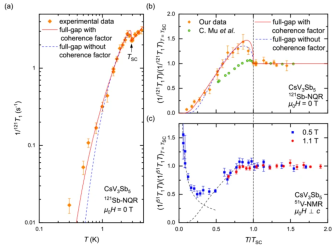
Crystal structure is known to have a significant effect on the properties of materials. Especially, crystals with partial lattice structures called sublattices have been attracting much attention because such structures can host fascinating phenomena including topological states, extended multipolar order, and unconventional superconductivity. One typical example of those structures is the kagomé lattice, which is […]

Loading

Read More

Peculiar Paramagnetism in YbCuS2 under Magnetic Fields

A magnetic semiconductor YbCuS2 has Yb zigzag chains, where the magnetic frustration is expected due to the competition between the nearest-neighbor exchange and next-nearest-neighbor exchange interactions. From the nuclear quadrupole resonance (NQR) measurements, we revealed that the system exhibits an incommensurate antiferromagnetic state with an ordered moment size smaller than the expected value below approximately […]

Loading

Read More

Absence of Charge-Neutral Quasiparticles in YbAgSe2

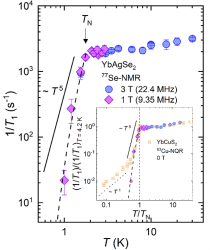
Frustrated systems, in which spin arrangement is not uniquely determined, have attracted attention because peculiar phenomena can occur. Recently, we found the T-linear behavior of the nuclear spin-lattice relaxation rate 1/T1 in the frustrated semiconductor YbCuS2 with a Yb zigzag chain. This behavior indicates the presence of charge-neutral quasiparticles. To investigate the origin and characteristics […]

Loading

Read More

Clear Reduction in Spin Susceptibility and Superconducting Spin Rotation for H || a in the Early-Stage Sample of Spin-Triplet Superconductor UTe2

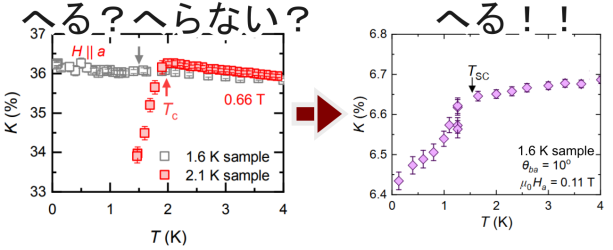
We report the re-measurement of the a-axis spin susceptibility component in an early-stage sample of the spin-triplet superconductor UTe2 with the transition temperature of TSC = 1.6 K. Using Knight-shift measurements along the b axis and at a 10-degree tilt from the b axis towards the a axis, we accurately determined the a-axis component without directly measuring the a-axis Knight shift. Our results reveal a decrease of […]

Loading

Read More

Breakdown of Kubo relation in Pt-Cu nanoparticle

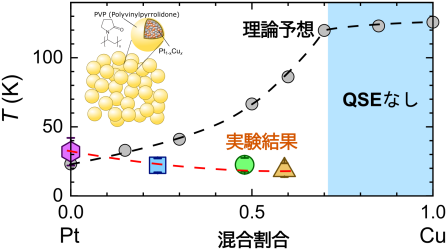
Nanoparticles were predicted to exhibit unique physical properties due to quantum size effects, but their identification remains difficult.According to Kubo’s theory, the gap size is inversely correlated with both the density of states at the Fermi energy and the number of atoms in the particle.Previously, we confirmed that the particle size and magnetic field dependence […]

Loading

Read More

Superconducting spin reorientation in spin-triplet multiple superconducting phases of UTe2

Superconducting (SC) state has spin and orbital degrees of freedom, and spin-triplet superconductivity shows multiple SC phases because of the presence of these degrees of freedom. However, the observation of spin-direction rotation occurring inside the SC state (SC spin rotation) has hardly been reported. Uranium ditelluride, a recently found topological superconductor, exhibits various SC phases […]

Loading

Read More