Even when a crystal structure is globally centrosymmetric (i.e., it possesses inversion symmetry), the absence of an inversion center at a specific atomic site is referred to as local inversion-symmetry breaking. In materials with such a crystal structure, the magnetic order can, in some cases, become an odd-parity magnetic order, meaning that it changes sign under an inversion operation. Such an order is expected to give rise to unusual phenomena known as cross-correlation responses.
LaMnSi exhibits local inversion-symmetry breaking at the Mn site, and it is known that the Mn 3d-electron spins form an antiferromagnetic order. However, the magnetic structure has remained unsettled because different structures have been proposed in previous studies. To clarify this issue, our group performed nuclear magnetic resonance (NMR) measurements using the Mn and La nuclei to investigate the low-temperature antiferromagnetic state.
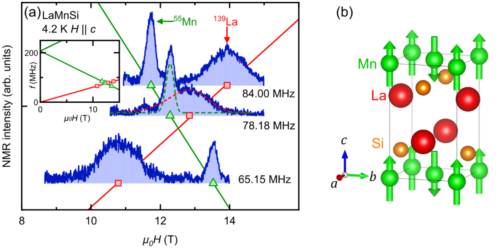
From the NMR spectra obtained under magnetic fields applied along the axis [Fig. (a)], we analyzed the relationship between the resonance frequency and the resonance field. This analysis microscopically revealed that the ordered magnetic moment of Mn is parallel to the axis, realizing the magnetic structure shown in Fig. (b). In addition, measurements of confirmed a metallic character with a finite residual density of states at low temperatures. As the temperature was increased toward the magnetic ordering temperature, we observed a growth of magnetic fluctuations.
These results demonstrate that a pure odd-parity magnetic order originating from the Mn 3d electrons is realized in metallic LaMnSi, suggesting that this material provides a promising platform for exploring cross-correlation responses such as current-induced strain.
This work was published online in the Journal of the Physical Society of Japan on December 26, 2025.

(a) NMR spectra measured under magnetic fields applied along the axis at various field strengths. The inset shows the field dependence of the peak positions.
(b) Magnetic structure determined from the NMR results.
